When ‘Down’ Is Not ‘Gone’: Designing Graceful Degradation for Concentrated Digital Dependencies
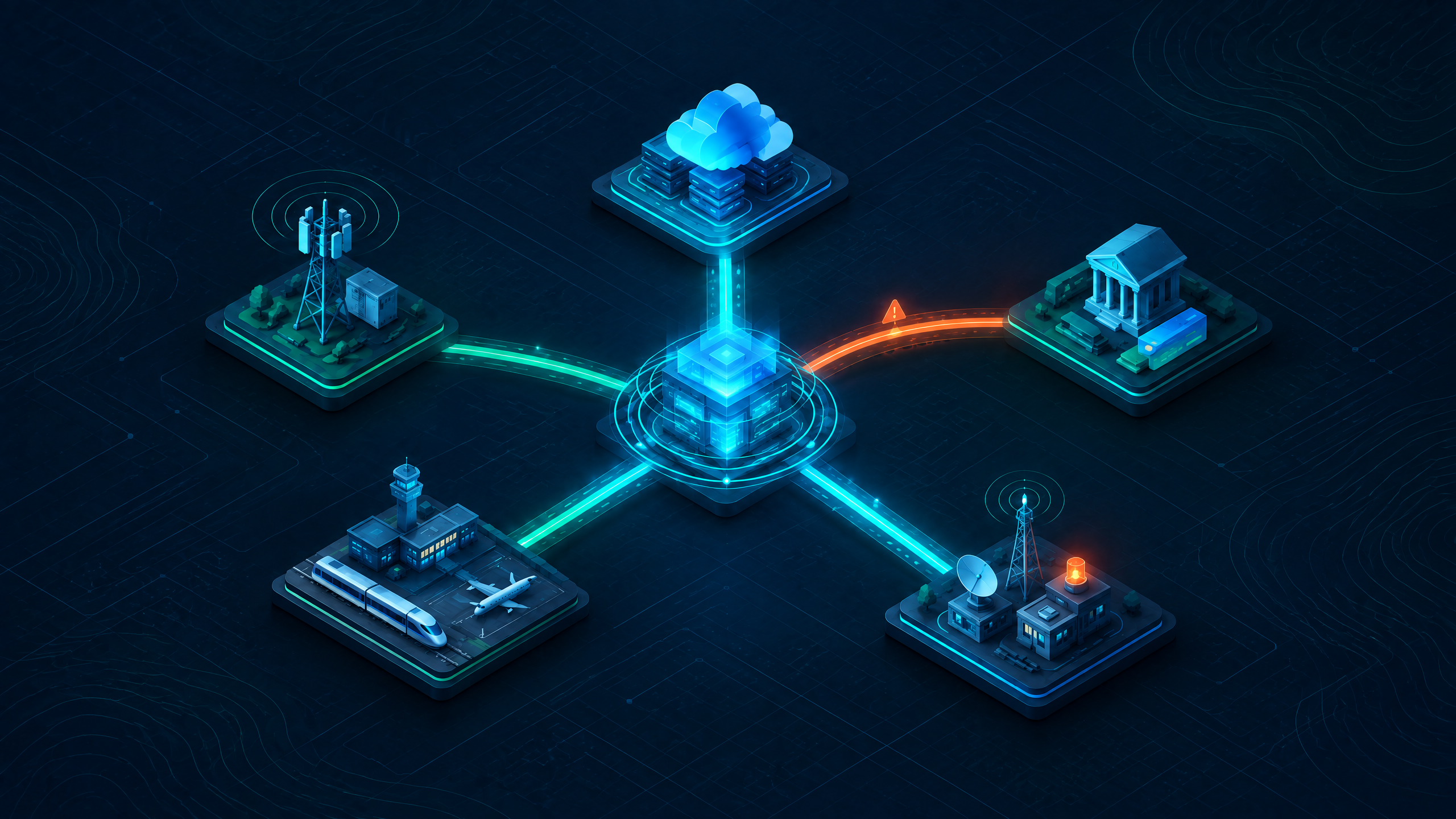
Most outage reporting starts with a binary question: is the service up or down? Recent cross-sector incidents point to a more useful question for technology, risk and operations leaders: which customer outcomes still work when a shared dependency fails, and how will the organisation know when recovery is genuinely complete?
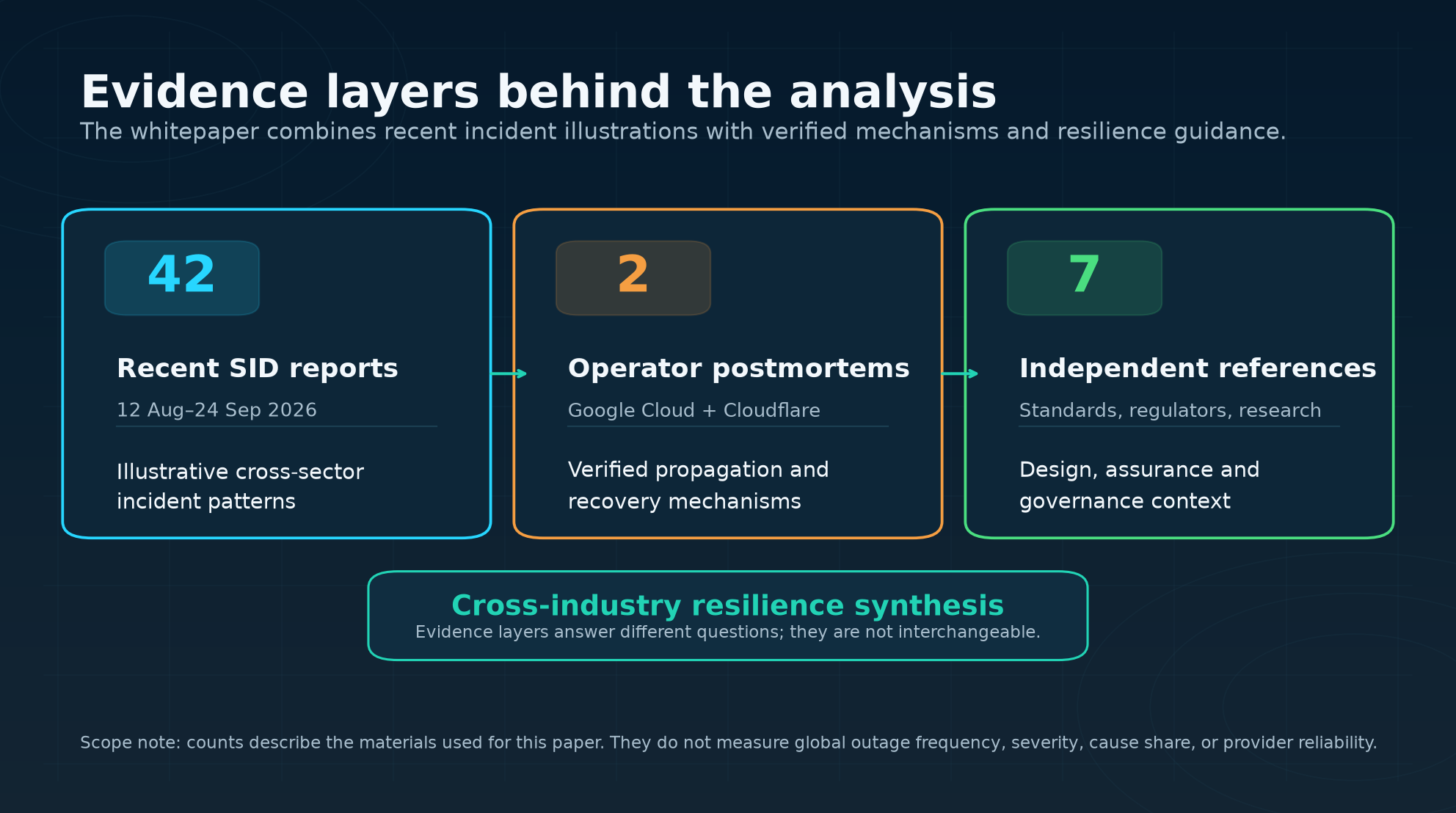
This whitepaper reviews a 42-post Status Is Down editorial corpus published from 12 August through 24 September 2026, then compares those illustrations with operator postmortems and regulatory or standards guidance. The corpus is not a statistically representative global outage dataset, so it cannot establish incident frequency, comparative reliability or a dominant cause. It can, however, expose recurring design questions across cloud platforms, telecommunications, banking, emergency communications and transport.
The central finding is that effective dependency concentration can turn a narrow control, environmental, routing, identity or processing failure into a multi-product incident. Graceful degradation can reduce that exposure by preserving a defined, safe and clearly communicated minimum service. Resilience should therefore be judged by critical outcomes and verified normalisation—not by a supplier count, a single availability percentage or the moment an upstream provider posts “resolved.”
Executive summary
An organisation’s most important dependency is not always its most visible vendor. It may be a shared authentication path, a configuration-distribution system, a core processor, a data-centre cooling plant, a carrier circuit, a status platform or a support channel. These functions form an effective dependency core: a small set of failure domains that can interrupt many branded services or customer journeys at once.
Graceful degradation is the practical counterweight. It means deliberately preserving a limited, safe and intelligible outcome during impairment. It does not mean silently accepting inferior service, assuming that one alternate channel works for every customer, or declaring success while queues and reconciliation work accumulate. The degraded mode needs explicit capacity, integrity and customer-communication boundaries, followed by a verified return to normal operation.
| Resilience question | Evidence leaders should require |
|---|---|
| Where is the dependency concentrated? | A map of logical, physical, administrative and third-party failure domains—not only a vendor list. |
| What remains safely usable? | A tested minimum service for each important customer or public outcome, with stated limits and alternatives. |
| When is recovery complete? | Evidence that backlogs, data integrity, regional service, support channels and dependent workflows have normalised. |
Where concentration hides
Logical concentration can be as consequential as a damaged cable or failed power supply. In Status Is Down’s Microsoft 365 and ChatGPT Work report, Microsoft attributed continuing impact to a core authentication configuration issue that reached Exchange Online and connected collaboration and security services. The ChatGPT event described in the same article was separate; proximity in time did not establish a common cause. A later multi-provider AI report applied the same safeguard: concurrent product incidents were not evidence of one shared cloud failure.
Two first-party postmortems show how propagation can amplify a narrow change. Google Cloud reported that unintended blank fields in quota-policy data replicated globally within seconds, exercised an inadequately protected Service Control code path and caused crash loops. Most regions began recovering after the policy path was disabled, while a restart herd effect extended recovery in a large region and some products had residual backlogs. Google also said that health and some customer monitoring infrastructure were impaired.
Cloudflare separately traced its November 2025 incident to a database-permission change that doubled a Bot Management feature file. The oversized file propagated across the network and exceeded a software limit. Cloudflare explicitly ruled out a cyberattack. Core traffic was largely normal by 14:30 UTC, but all systems were not reported normal until 17:06 UTC. These mechanisms do not explain the 2026 incidents; they demonstrate why configuration generation, validation, rollout, rollback and observability belong inside the production failure model.
Physical and operational concentration can also defeat a nominal backup. In the Northeast airport telecommunications incident, a primary communications circuit failed while a backup fibre route was also unavailable after being severed. Repairs allowed operations to resume, but accumulated flight disruption remained. A second line on a diagram is not proof of resilience if it shares a corridor, facility, control plane, power source or repair constraint with the first.
Partial service is not the same as availability
The finance cases show why customer outcomes should be assessed separately. During a UK app impairment, the Monzo report described an independent backup-bank arrangement and continued card payments, cash withdrawals, card freezing and transfers while some app functions were limited. In the NAB incident, digital banking, trading and phone contact were affected, while ATMs and fast payments remained available and a Direct Entry deadline was extended. Neither example means that every customer had an adequate substitute; it shows that an organisation can design continuity around specific tasks rather than one front end.
Shared dependencies can produce uneven impact. Status Is Down’s Mastercard processor roundup documented different processor and route states, without claiming a universal payment failure or a final technical cause. The Sharetec report described institution-specific disruption after affected credit unions attributed the incident to cooling and failover problems at a shared core-services provider. Core restoration did not automatically mean that balances, digital banking and every member workflow were reconciled at the same time.
That outcome-led framing is reflected in APRA’s CPS 230. For regulated Australian institutions, it requires tolerances for maximum disruption, data loss and minimum service under alternative arrangements for critical operations. The FFIEC likewise calls for analysis of single points of failure and dependencies across core processing, online and mobile banking, settlement, utilities and third parties. These are sector-specific requirements and guidance, not universal legal rules, but the design principle travels well: define the task that must continue before selecting the backup.
Emergency communications and transport expose path-specific risk
Emergency communication is not one path. The Oklahoma 911 report distinguished wireline call completion from wireless routing problems and described alternate ten-digit lines and transfers used during the disruption. It did not establish that every Oklahoma call centre failed simultaneously, and no reviewed source supplied a failed-call total or more specific root cause. Similar care is necessary whenever voice, text, location data, routing and local call-centre delivery have different states.
In the United States, the FCC requires covered providers to complete 911 calls, transmit location information, address circuit diversity, backup power and monitoring, and notify affected 911 facilities of outages that may affect them. Those rules are jurisdiction-specific. During any active emergency-service disruption, readers should follow current instructions from the relevant local authority rather than treating a general monitoring or news page as a substitute.
Transport systems make the recovery tail visible. Restored communications can reopen an operating path while aircraft, crews and passengers remain out of position. Repaired rail infrastructure can permit service while residual delays continue. The lesson is not that every transport incident shares an upstream cause; it is that the status of the enabling asset and the status of the public outcome are different operational facts.
Recovery is a sequence, not a label
Precise recovery language reduces false reassurance and makes verification easier. A practical four-stage model is:
- Containment: the failure is isolated or its propagation is stopped.
- Minimum capability restored: a defined critical outcome or safe alternate path is available within its stated limits.
- Normalisation in progress: queues, delayed jobs, regional capacity, customer support, data consistency and dependent workflows are being cleared or checked.
- Recovery declared complete: integrity and normal operating status have been verified against explicit closure criteria.
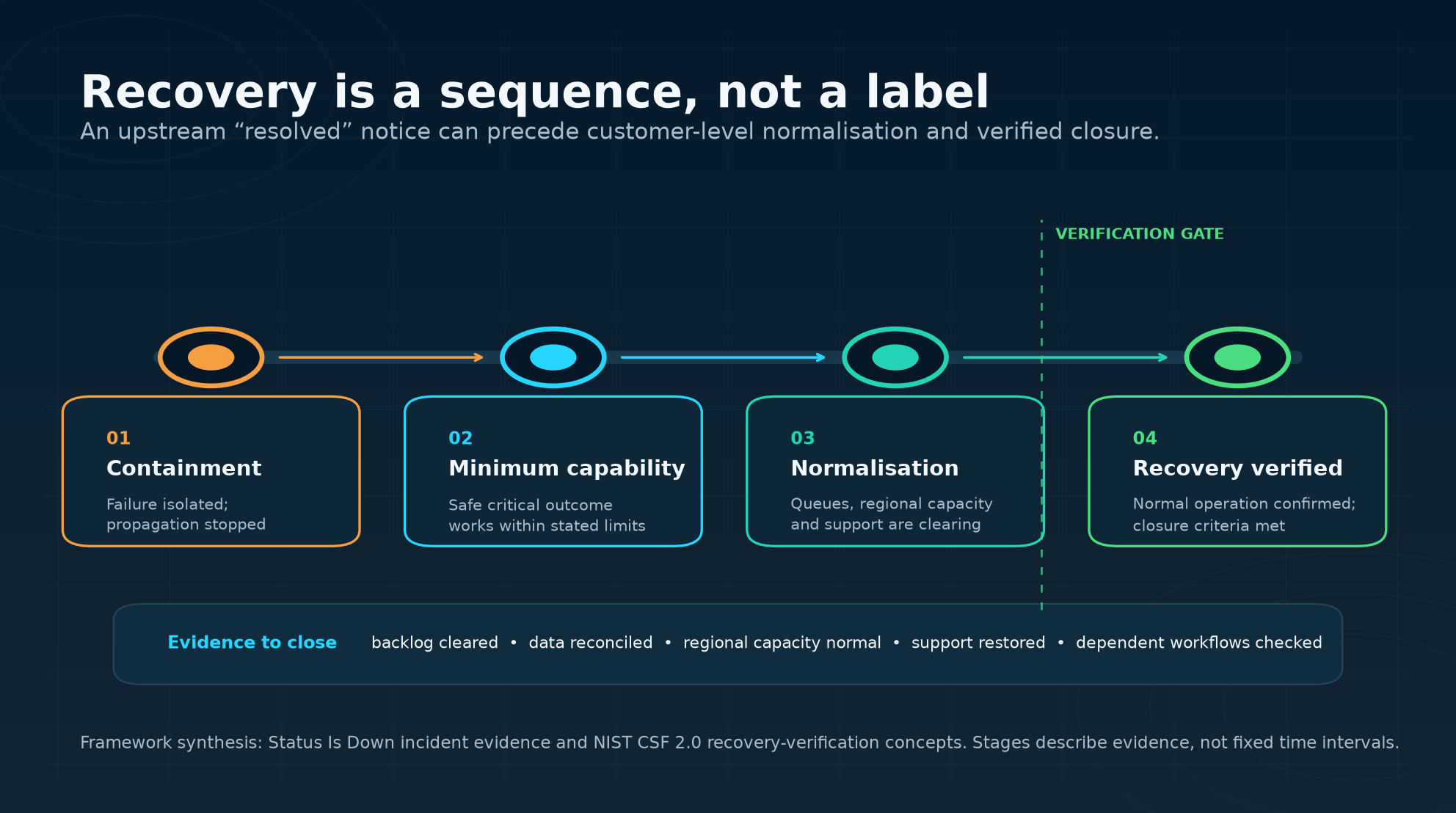
This distinction appears in the incident evidence. J:COM reported listed-service recovery while customer-centre calls remained difficult. The airport telecom repair allowed operations to resume before schedules normalised. Google Cloud and Cloudflare both recorded a gap between broad or core recovery and the end of residual effects.
The NIST Cybersecurity Framework 2.0 formalises the verification step for cyber incidents: recovery actions are selected and prioritised, restoration assets are checked, restored-asset integrity and normal operating status are confirmed, and the end of recovery is declared against criteria. The same discipline is useful beyond cybersecurity, even where the incident begins with power, cooling, telecommunications or an operational error.
A five-part programme for graceful degradation
First, map the important outcome and every failure domain that enables it. Follow identity, DNS, edge delivery, control planes, APIs, processors, data centres, carriers, monitoring and support, including fourth parties and physical routes. The EU’s DORA framework treats critical ICT third-party concentration as an operational-resilience concern in finance; other sectors can use the same analytical lens without assuming the regulation applies to them.
Second, define the minimum viable mode. State which customer tasks continue, what data may be delayed, who receives priority, what capacity limit applies and how deferred work will be reconciled. An alternate that is unsafe, inaccessible or too small for demand is not a credible degraded service.
Third, engineer containment and failover. Depending on the system, controls may include staged rollout, validation, feature flags, kill switches, bounded retries, randomised exponential backoff, circuit breakers, queues, caches, session policy and manual workarounds. Google’s postmortem identified several of these as remediation areas; the exact control set must fit the service and its risk.
Fourth, preserve independent observability and communication. The status page, monitoring stack and support channel may share the same dependency as production. Organisations should identify a separate way to observe customer outcomes and publish approved updates that distinguish symptoms, confirmed scope, cause status, workarounds, capability restoration, normalisation and closure.
Fifth, exercise the combined failure. The FCA’s operational-resilience guidance asks firms in scope to map people, processes, technology, facilities, information and third parties, then test severe but plausible scenarios. It also distinguishes recovery-time objectives from impact tolerances and notes that response actions can buy time while recovery completes. A useful exercise should therefore test dependency loss, partial service, unavailable normal communications, support overload and backlog clearance together—not only whether a backup server starts.
Measures boards can use
A single availability percentage cannot show whether a customer completed a payment, reached emergency services, checked in for a flight or accessed a critical account function. Outcome-led measures can include time to detect, time to the first usable contingency, the percentage or volume of critical tasks completed safely, queue age, reconciliation exceptions, support-channel availability, time to verified normal operations and unresolved recovery risks.
Uptime Institute’s 2026 analysis provides broader context: it reports that per-site outage frequency declined for a fifth year, while external infrastructure failures became more prominent in publicly reported outages and fibre and connectivity incidents were more likely to produce extended disruption. Its evidence combines surveys, public reports, members, partners and its own database. Those findings should not be treated as a census of the Status Is Down corpus, but they reinforce the need to look beyond internal equipment and map external dependencies.
What this means for Status Is Down users
Status Is Down can support that work by helping teams compare current user signals with operator updates across its website records, service directory and real-time dashboard. These resources supplement, rather than replace, official provider, emergency or transport instructions.
Creating an account and selecting a monitoring plan can help teams follow the external services they depend on and add context to their own telemetry. The larger resilience task remains organisational: define the critical outcome, test the degraded mode and verify the path back to normal. Readers can also explore additional research in the Industry Whitepapers collection.
Methodology and limits
The Status Is Down material used here is an editorially selected, source-linked corpus, not a prevalence study. Article counts cannot support claims about frequency, severity, geography, duration, comparative reliability or root-cause share. Contemporaneous reports may also be revised by later operator analysis. Cause language therefore remains narrow: confirmed where a postmortem exists, attributed where an operator or institution supplied an account, and undisclosed where the evidence did not establish more.
Concurrency is not causality. Similar symptoms or overlapping timing do not prove a shared cloud, carrier, cyberattack, sabotage event or supplier failure. Partial availability is also not proof of harmlessness: an ATM, card route, alternate number or text channel may have eligibility, capacity, accessibility or geographic limits. Finally, the regulatory sources in this paper describe their own sectors and jurisdictions and should not be read as legal advice.
Conclusion
A resilient service does not promise that every component will remain available forever. It makes dependency boundaries visible, limits the blast radius, preserves defined critical outcomes where safe, communicates what users can and cannot do, and declares recovery complete only after verification. For leaders reviewing recent outage trends, graceful degradation is not a softer version of uptime; it is the operating discipline that turns concentrated dependencies into bounded, measurable risk.
Sources
- Status Is Down: Microsoft 365 outage leaves small subset affected into third day; ChatGPT Work recovers after five-hour disruption
- Status Is Down: ChatGPT and Claude outages hit AI users as reports spread across Gemini, Copilot and Grok
- Status Is Down: Cuba begins grid recovery after nationwide blackout; Sharetec outage disrupts credit unions
- Status Is Down: J:COM restores broadband after widespread Japan disruption; NAB resolves digital banking outage
- Status Is Down: Northeast airport operations resume after telecom outage; Michigan State utility recovery continues
- Status Is Down: Mastercard payments fail worldwide: five processors report errors before recovery begins
- Status Is Down: Monzo activates backup bank amid UK app outage; IndiGo reservation glitch blocks bookings in India
- Status Is Down: Oklahoma restores 911 routing after network issue; downed poles disrupt Long Island rail service
- Google Cloud: Multiple GCP products are experiencing Service issues
- Cloudflare: Cloudflare outage on November 18, 2025
- Uptime Institute: Annual Outage Analysis Report 2026
- National Institute of Standards and Technology: The NIST Cybersecurity Framework (CSF) 2.0
- Financial Conduct Authority: Operational resilience: insights and observations for firms
- Federal Communications Commission: 911 Reliability
- Australian Prudential Regulation Authority: Prudential Standard CPS 230 Operational Risk Management
- European Insurance and Occupational Pensions Authority: Digital Operational Resilience Act (DORA)
- Federal Financial Institutions Examination Council: Business Continuity Management: Interdependency Analysis
Image credit: Illustration generated for Status Is Down