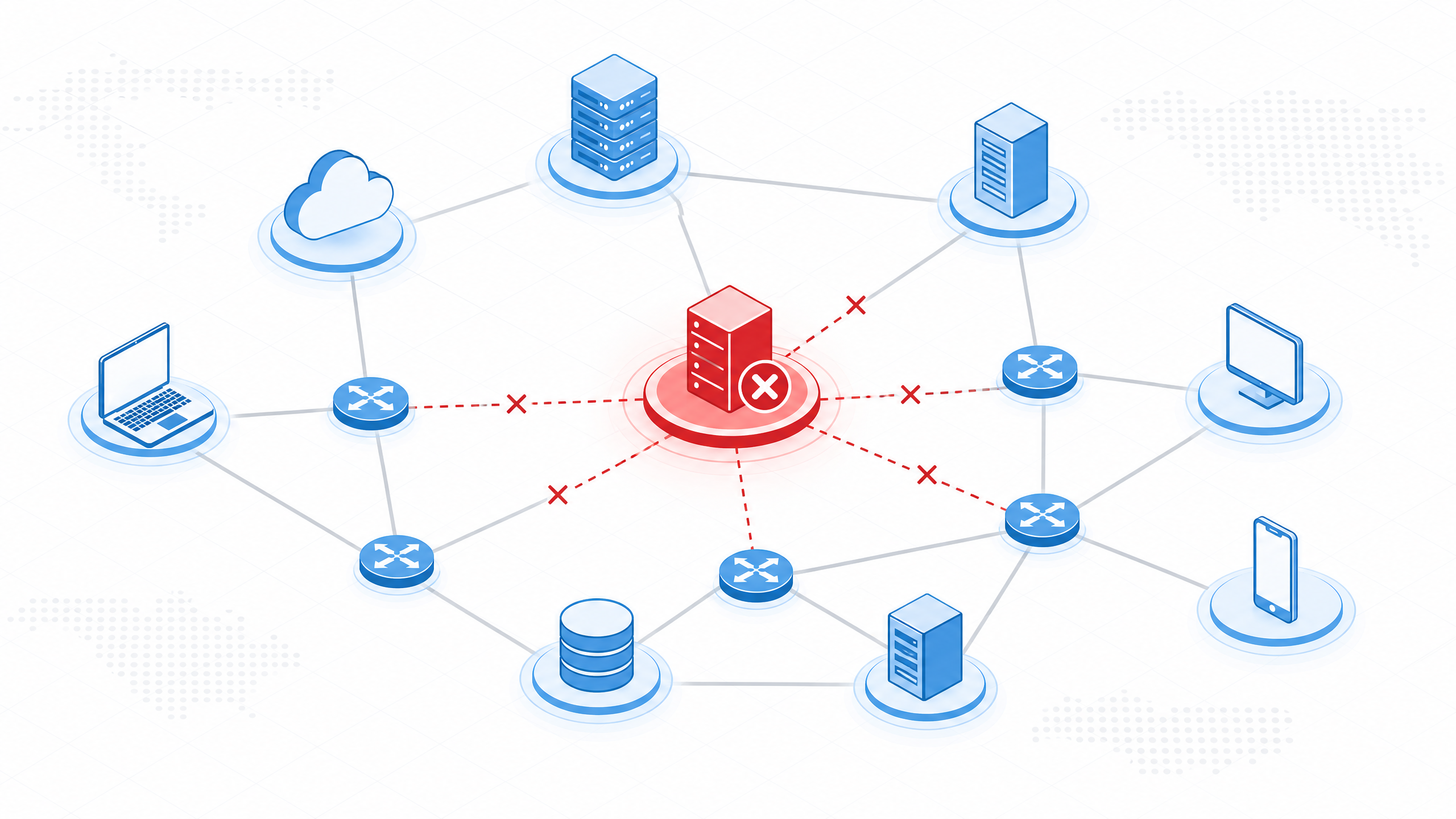
What Happens When a Website Goes Down? A Simple Guide to Internet Outages
Every day, millions of people encounter the same frustrating experience: they try to open a website or app, and nothing loads. Whether it is a social media platform, a banking portal, or a streaming service, the result is the same — a blank screen, a spinning wheel, or a cryptic error message. But what actually happens behind the scenes when a website “goes down”? And why does it seem to be happening more often?
This guide breaks down the mechanics of internet outages in plain language, explains the most common causes, and helps you understand why even the largest technology companies in the world are not immune to downtime.
The Scale of the Problem
Internet outages are far more common than most people realise. According to Cloudflare’s 2025 Year in Review, their monitoring systems detected 174 major internet outages globally throughout 2025 — an average of more than three significant disruptions every single week. Global network outages increased by 33.38% from January to May 2025 alone, rising from 1,382 to 1,843 tracked incidents.
The financial impact is equally staggering. Research from the Uptime Institute shows that 54% of organisations experienced an outage costing more than $100,000, while 41% of enterprises report that a single hour of downtime costs them over $1 million. Government-imposed internet shutdowns alone cost the global economy $19.7 billion in 2025.
These are not abstract numbers. When a major platform goes offline, it affects real people — workers who cannot access their tools, businesses that lose revenue by the minute, and individuals who depend on digital services for communication, healthcare, and daily life.
How the Internet Actually Works (In Simple Terms)
To understand why websites go down, it helps to understand how they stay up in the first place. When you type a web address into your browser, a remarkable chain of events occurs in milliseconds:
Step 1: DNS Lookup. Your browser asks a Domain Name System (DNS) server to translate the human-readable address (like “statusisdown.com”) into a numerical IP address that computers understand. Think of DNS as the internet’s phone book.
Step 2: Routing. Your request travels across the internet through a series of routers and switches, following paths determined by the Border Gateway Protocol (BGP) — essentially the internet’s GPS navigation system.
Step 3: Server Processing. Your request arrives at the destination server (or more likely, a cluster of servers in a data centre), which processes it and prepares the webpage content.
Step 4: Content Delivery. The response travels back to your device, often passing through a Content Delivery Network (CDN) — a global network of servers that stores copies of content closer to users for faster delivery.
Step 5: Rendering. Your browser assembles all the pieces (HTML, images, scripts) and displays the page.
A failure at any single point in this chain can cause what we experience as “the website is down.” The internet is remarkably resilient, but it is also remarkably complex — and complexity breeds failure.
The 7 Most Common Causes of Internet Outages
Based on data from the Uptime Institute, Cloudflare, and ThousandEyes, here are the primary reasons websites and services go offline:
1. Server Overload (Traffic Spikes)
When far more people try to access a service simultaneously than its infrastructure can handle, servers become overwhelmed. This is like a motorway designed for 10,000 cars suddenly receiving 100,000 — everything grinds to a halt. Major product launches, breaking news events, and viral social media moments frequently trigger this type of outage.
2. DNS Failures
Since DNS is the internet’s address book, when it fails, browsers simply cannot find where to send your request. DNS issues are a frequent and often overlooked cause of downtime. Expired domains, incorrect DNS records, or misconfigured nameservers can make an entire website unreachable even though the actual server is running perfectly. The October 2025 AWS outage, which affected 113 services for over 15 hours, was triggered by a DynamoDB update that cascaded into DNS failures.
3. Configuration Errors (Human Mistakes)
The Uptime Institute reports that the failure of staff to follow procedures has become an even greater cause of outages than in previous years. A single misconfigured setting — a wrong number in a routing table, an accidentally deleted database entry, or a firewall rule that blocks legitimate traffic — can take down an entire platform. The Azure Front Door outage on October 29, 2025, which disrupted Office 365, Teams, and Xbox Live for approximately 9 hours, was caused by an “unintentional configuration change.”
4. Hardware Failures
Physical equipment breaks. Hard drives fail, memory chips degrade, network cables get damaged, and power supplies burn out. While modern data centres build in redundancy (backup systems for every component), cascading hardware failures can still overwhelm these safeguards. Power remains the single leading cause of impactful data centre outages according to the Uptime Institute.
5. Software Bugs and Bad Updates
Sometimes the very updates meant to improve a service are what bring it down. The most dramatic example in recent history was the CrowdStrike incident, where a defective Falcon security update affected more than 8.5 million Microsoft Windows devices simultaneously. This single software bug caused Fortune 500 companies to lose an estimated $5.4 billion in revenue.
6. Network and Cable Damage
The global internet depends on physical infrastructure — including undersea fibre optic cables that carry data between continents. On September 6, 2025, submarine cables in the Red Sea were cut, disrupting nearly 25% of internet traffic between Asia, Europe, and the Middle East. On land, construction work accidentally severing fibre cables is a surprisingly common cause of regional outages.
7. Cyberattacks (DDoS)
A Distributed Denial of Service (DDoS) attack floods a website with so much fake traffic that it cannot serve real users. These attacks have grown in sophistication and scale, with some generating traffic volumes measured in terabits per second. While DDoS attacks do not steal data, they effectively make services unavailable — which is the entire point.
Why Outages Are Getting More Complex
An important trend is emerging in the data: while individual data centre outages are becoming less frequent (down from 53% to 50% of facilities experiencing an outage over three years), internet-level disruptions are climbing. As one analysis noted, “failure is migrating up the stack — from data-centre power to DNS, BGP, and CDN edges.”
This means outages are increasingly caused not by a single server failing, but by problems in the interconnected systems that tie everything together. When a cloud provider like AWS or Azure experiences an issue, it does not just affect one website — it can cascade across hundreds of services that depend on that infrastructure.
The rise of artificial intelligence is adding new strain. Growing demand for AI workloads is challenging power and cooling systems, while aging grid infrastructure and intermittent renewable energy create new power-stability risks for data centres.
What You Can Do When a Service Goes Down
When you encounter an outage, here are practical steps:
Confirm it is not just you. Check a community-driven outage tracker like Status Is Down to see if others are reporting the same issue. If thousands of people are reporting problems simultaneously, the issue is on the service’s end, not yours.
Check your own connection. Restart your router, try a different device, or switch between Wi-Fi and mobile data. Sometimes what feels like a website outage is actually a local connectivity issue.
Wait it out. Most outages resolve within minutes to hours. The median resolution time for significant outages is improving year over year as companies invest in faster incident response.
Have alternatives ready. For critical workflows, identify backup tools in advance. If your primary email goes down, know how to access a secondary account. If your video conferencing platform fails, have a backup option ready.
Stay informed. Follow outage tracking services on social media (like @Status_Is_Down on X) to receive real-time alerts about major disruptions.
The Bottom Line
Internet outages are not going away. As our dependence on digital services deepens and infrastructure grows more interconnected, the potential blast radius of a single failure point only increases. The good news is that the industry is learning — overall outage severity is declining even as the internet grows more complex.
Understanding what happens when a website goes down transforms the experience from a mysterious frustration into something comprehensible. The next time you see a loading spinner that never resolves, you will know that somewhere in the chain — from DNS to routing to servers to cables — a link has broken. And somewhere, an engineering team is already racing to fix it.
Want to know the moment a service you depend on goes down? Download the Status Is Down app and set up personalised outage alerts for the services that matter to you.