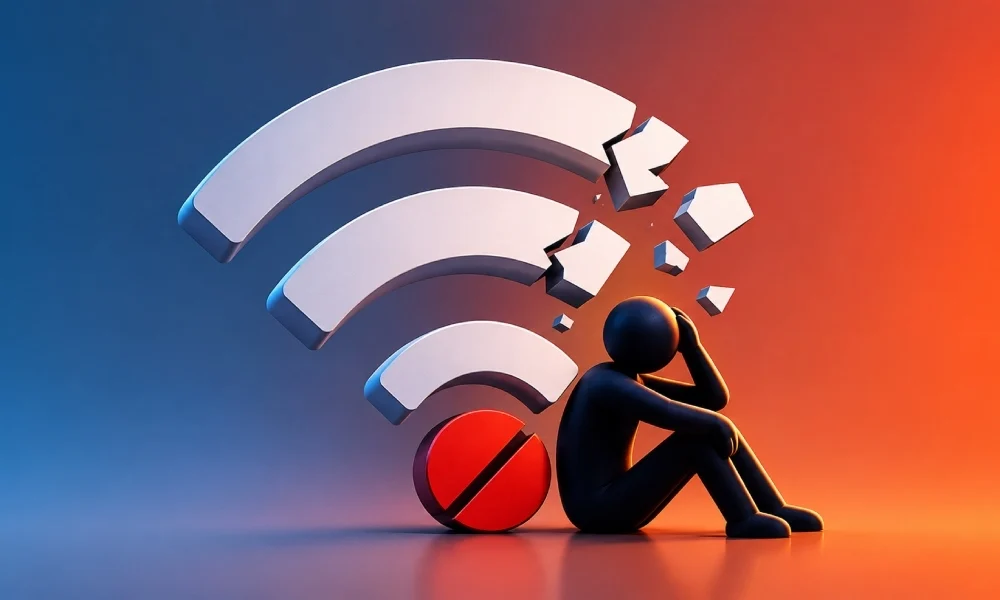
The seven waves of outage complaints—how the internet reacts when a service goes down
Every outage has two stories. There is the technical failure, and then there is the emotional fallout. Only one of these ever appears on an official status page. The other spills across social platforms in real time, carried by confused users, frustrated workers and people who simply want to know why nothing is loading.
After watching thousands of outage reports roll in across Status Is Down, social platforms and late‑night panic posts, a clear pattern emerges. Outage complaints follow the same emotional arc every single time, no matter which service collapses. It has become a predictable script for digital chaos, denial and collective therapy.
This is the anatomy of an outage complaint—the seven stages people move through when the internet stops behaving and the world briefly feels like it is falling apart.
1. The First Wave: “Is it just me?”
This is the soft‑panic phase. Users are unsure, and convinced their router is the villain.
Typical lines:
- “Anyone else having issues”
- “Is it down or is my Wi‑Fi dying again”
- “Why is nothing loading”
People reboot their phones, toggle airplane mode, and glare at their modem like it owes them money. This wave usually appears a few minutes before the outage becomes obvious to everyone else.
2. The Second Wave: “This service is ruining my life.”
Once people confirm it is not their fault, the tone shifts fast. Confusion turns into melodrama almost immediately.
Cue the dramatic lines:
- “I can’t work because of this”
- “My entire workflow is stuck”
- “I was in the middle of something important”
Banking, telecom and productivity outages trigger the most emotional reactions. Gaming and streaming outages are louder but less existential. This is the moment the complaint volume shoots upward.
3. The Third Wave: The Speculation Surge
Now the internet turns into a courtroom. People start assigning responsibility based on whatever they are seeing on their own devices, and the finger‑pointing begins.
Common assumptions:
- Blaming the ISP for a cloud outage
- Blaming the app for an authentication outage
- Blaming “the servers” for a local device issue
- Blaming “the update” even when no update has happened in months
Identity provider outages create the most confusion because many people do not realise multiple apps share the same login layer. This is the phase where quick conclusions, personal theories and on‑the‑spot interpretations spread the fastest, often making the outage feel bigger or stranger than it actually is.
4. The Fourth Wave: Outrage, Memes and Collective Therapy
Once enough people are affected, the internet shifts into group‑therapy mode.
You will see:
- Memes about the outage
- Screenshots of cryptic error messages
- “The whole world is down” exaggerations
- Jokes about switching platforms
- People admitting “I came here to check if it’s down”
Nothing unites people like shared suffering. This is also when engagement spikes the highest.
5. The Fifth Wave: The Behind‑the‑Scenes Theories
By this point, the outage is widely acknowledged. Status pages may have updated, services might have posted a vague “we’re investigating,” and users feel they finally have enough clues to piece together what’s happening behind the scenes.
This is when people shift from who’s at fault to what must be going wrong.
Popular theories:
- “It’s a DDoS attack”
- “They’re doing maintenance”
- “The servers are overheating”
- “It’s the new update”
- “Too many players logged in at once”
Gaming outages in particular spark the most dramatic explanations. If a major title stutters for a moment, someone will swear the servers are melting or that the latest patch broke everything. This phase feels more technical, more certain, and sometimes more dramatic than the outage itself.
6. The Sixth Wave: Acceptance and Workarounds
Once the outage is fully acknowledged, people shift from panic to problem‑solving. This is the shortest and most practical phase, where the goal is simply to get things working again.
Common workarounds:
- “Switch to mobile data, it works”
- “Use the web version instead of the app”
- “Reinstall the app.”
- “VPN fixes it”
It is the closest the internet ever gets to teamwork—a brief moment where strangers trade fixes, compare notes and collectively try to patch the digital world back together.
7. The Final Wave: Post‑Outage Debrief
The outage ends. The post‑mortem begins.
Users immediately begin their review:
- “It’s back for me”
- “Still broken here”
- “This happens too often”
This is where long‑term sentiment settles in. Services with frequent outages — telecom providers, banking apps, gaming platforms tend to carry a permanent cloud of frustration, even when the disruption is minor.
People forgive, but they rarely forget.
In the end, outage complaints are more than noise. They are a real‑time snapshot of digital dependence, frustration and the small rituals we all fall into when the internet stops cooperating. The systems may recover quickly, but the reactions tell the deeper story of how tightly our lives are wired into the services we use every day.
Source: https://community.designtaxi.com/forum/65-status-is-down-outages-downtime/
Image: Ai-generated