Mastercard Payments Fail Worldwide: Five Processors Report Errors Before Recovery Begins
Card payments on the Mastercard network began failing in the early hours of Friday 15 August, and within an hour five separate payment companies had posted technical notices describing the same problem from five different vantage points. Mastercard has since confirmed it is experiencing an issue, and by 05:30 UTC at least one gateway was reporting that transactions had started to recover.
This account is built entirely on first-party status disclosures from the payment processors themselves, each timestamped and quoted below, because at the time of writing no wire service or mainstream newsroom had reported the disruption. Mastercard operates no public status page and has issued no statement of its own.
Worldpay raised the first flag at 04:28 UTC
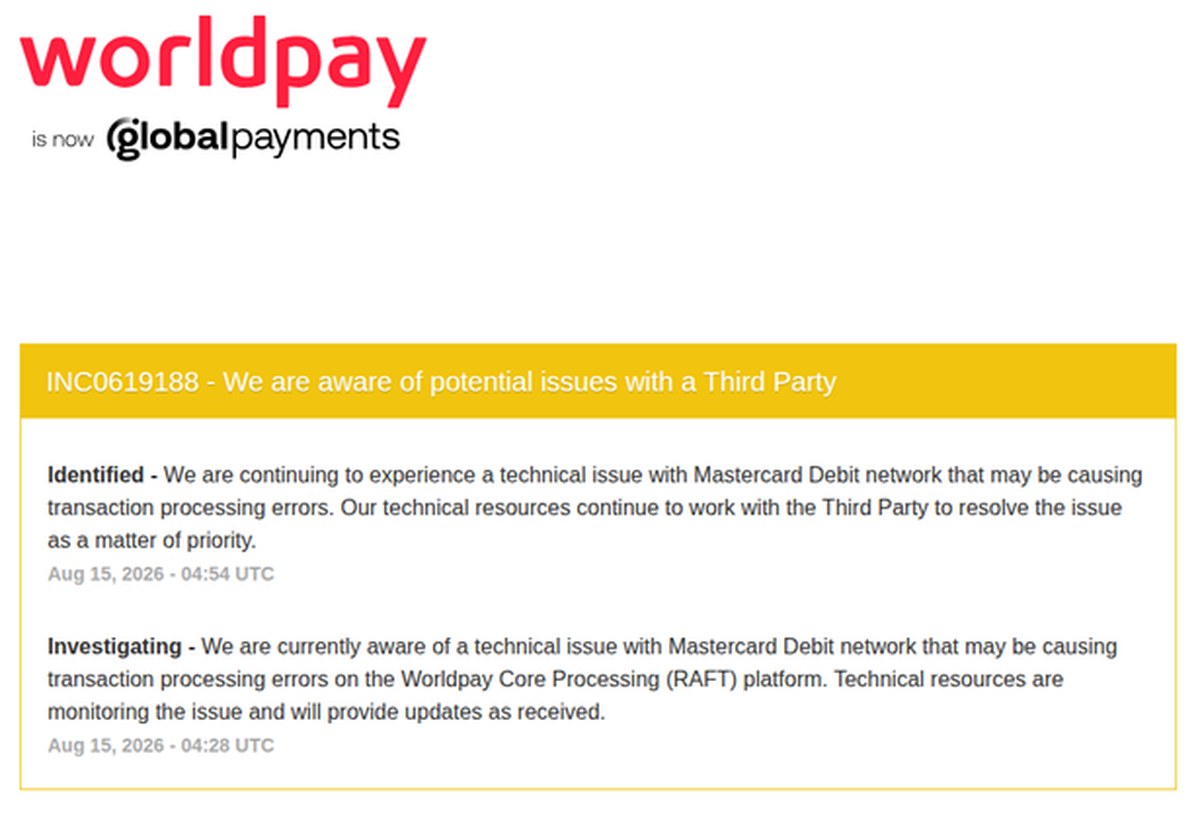
The earliest notice came from Worldpay, now part of Global Payments, which opened incident INC0619188 at 04:28 UTC reporting “a technical issue with Mastercard Debit network that may be causing transaction processing errors” on its core processing platform. By 04:54 UTC the incident had moved from investigating to identified, with Worldpay saying its technical teams were working with the third party “as a matter of priority”. Its authorisation and payments component was marked as degraded while acquiring, payouts and reporting stayed normal.
Windcave named the failure code
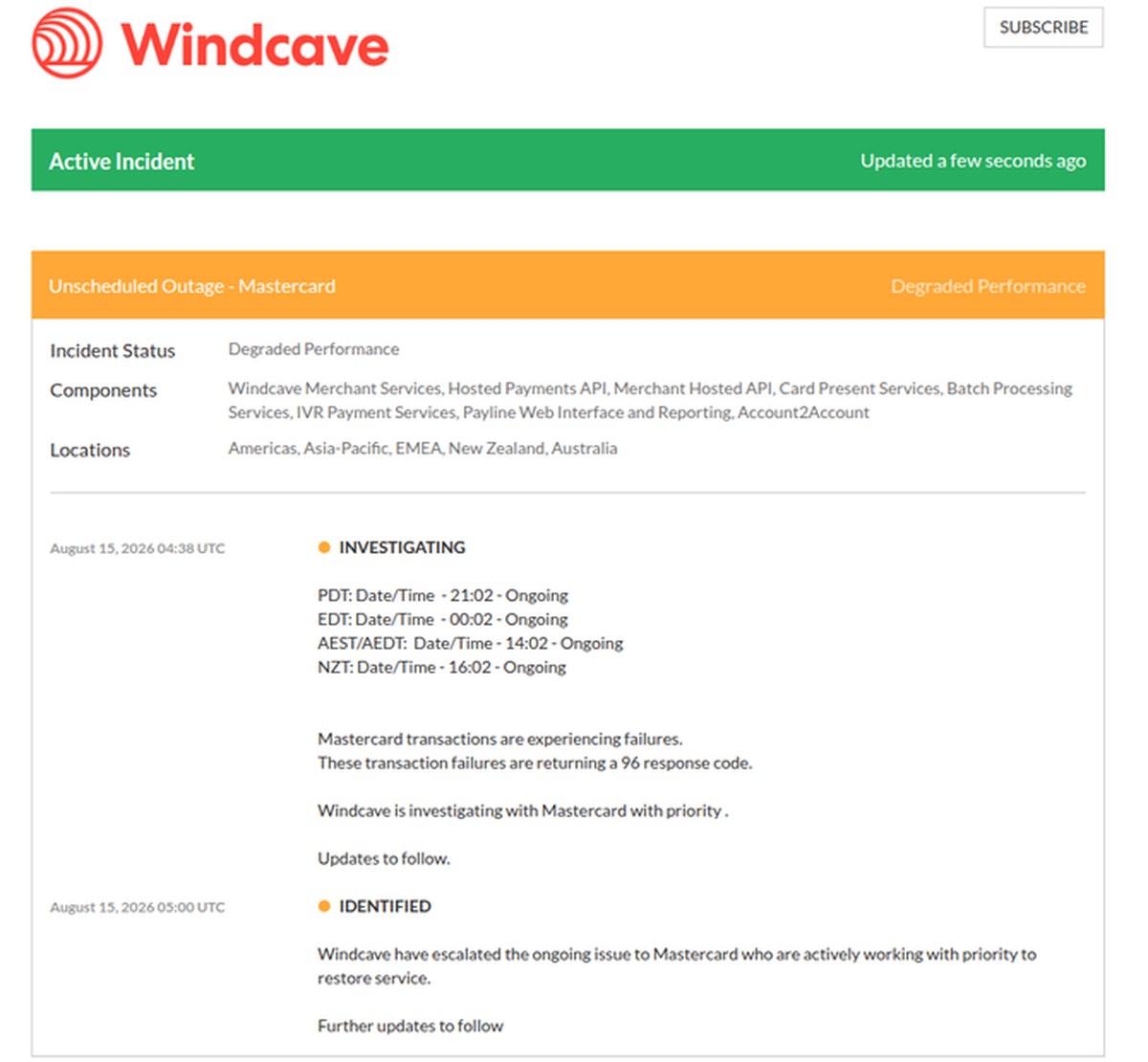
Windcave, a gateway operating across New Zealand, Australia, the Americas and EMEA, was the most specific about the failure mode. It titled its incident an “Unscheduled Outage – Mastercard” at 04:38 UTC and reported that failing transactions were returning a 96 response code. In the ISO 8583 messaging standard that banks and card networks use to talk to one another, response code 96 means system malfunction — a fault somewhere in the processing chain, rather than a decision to decline an individual card. By 05:00 UTC Windcave said it had escalated to Mastercard, which was “actively working with priority to restore service”. Eight of Windcave’s own components were listed as degraded across five regions, including card-present services used at physical checkouts.
Stripe confirmed the fault was outside its own systems
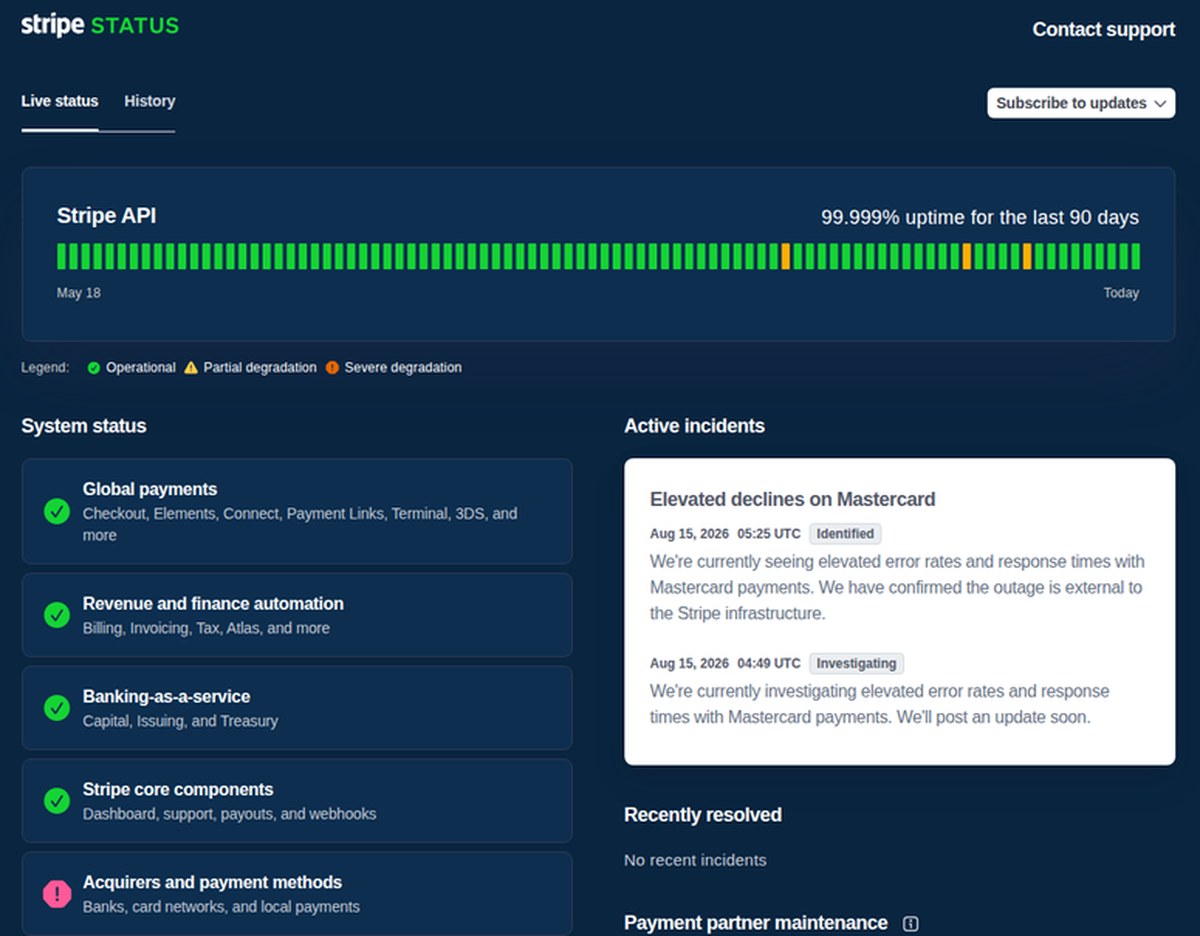
Stripe opened an incident titled “Elevated declines on Mastercard” at 04:49 UTC and hardened its language at 05:25, stating that it had “confirmed the outage is external to the Stripe infrastructure”. Its dashboard made the distinction visible: global payments, billing, banking-as-a-service and core components all showed operational, while the single component covering acquirers and payment methods — banks, card networks and local payment methods — was flagged as a major outage.
Adyen relayed Mastercard’s own confirmation
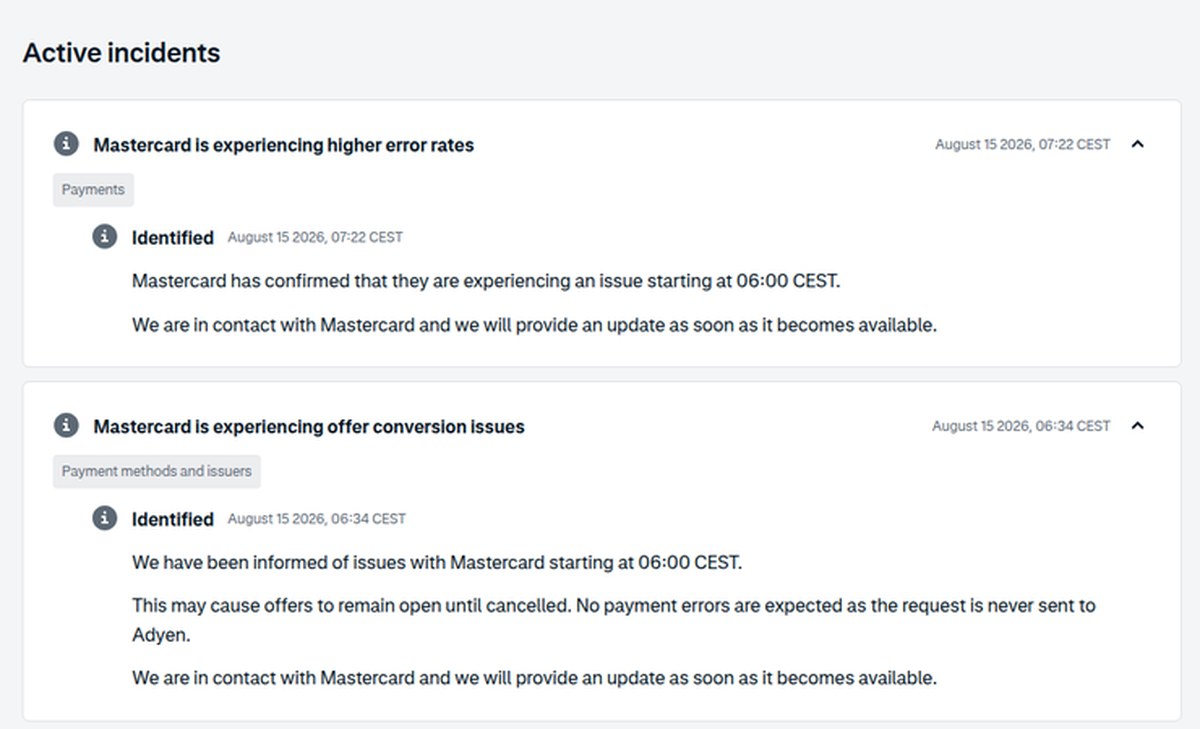
Adyen provided the closest thing to an official word from the network itself. The Dutch processor first logged a narrow problem at 06:34 CEST, saying it had been informed of issues with Mastercard but expected no payment errors on its own side. Less than an hour later it opened a second, broader incident against its payments component, stating plainly: “Mastercard has confirmed that they are experiencing an issue starting at 06:00 CEST.” That start time corresponds to 04:00 UTC.
How far it reached
The broadest picture comes from Cybersource, the Visa-owned gateway, which recorded a start time of 04:01 GMT and described the cause only as a “Financial Ecosystem Participant Disruption” — a failure at a financial participant that “may be impacting some cardholders ability to make payments”. Cybersource does not name Mastercard anywhere in its notice, and stressed that nothing within its own platform was at fault.
Its component list is where the scale becomes legible. Roughly fifty individual acquirer connections were showing degraded performance at the same moment — among them Chase Paymentech, Bank of America Merchant Services, Barclays, HSBC, Elavon, Moneris, TSYS, Lloyds Cardnet, Streamline, Cielo, Rede, Prosa, Saudi Payments, China UnionPay, RuPay and FDI Australia — while Cybersource’s own APIs, portals, risk tools and settlement services stayed operational. A single shared dependency failing upstream produces precisely that signature, and the geography of those acquirers spans North and South America, Europe, the Middle East, India and Asia-Pacific.
Impact was not uniform, and it appears to have depended on how each processor routed its Mastercard traffic. Klarna and GoCardless reported normal service throughout, as did Authorize.net — notable because, like Cybersource, it is Visa-owned, yet showed every acquirer connection healthy. The affected operators also described different symptoms: Worldpay named Mastercard debit traffic specifically, Adyen’s first notice expected no payment errors at all, while Windcave and Stripe saw outright transaction failures.
Signs of recovery
At 05:36 UTC Windcave moved its incident from identified to monitoring, reporting that Mastercard transactions had begun processing again from approximately 05:30 UTC. That puts the period of disruption on Windcave’s route at roughly ninety minutes, from about 04:01 UTC. All eight of its components remained listed as degraded while it continued to monitor.
Recovery was not universal at that point. Stripe’s incident was still open and its acquirers component still showed a major outage, and neither Worldpay nor Adyen had marked their incidents resolved. Readers experiencing failures should not assume the problem has cleared everywhere.
What is still unknown
Mastercard has not published a statement of its own, and its confirmation is known only second-hand through Adyen. No processor has given transaction volumes, affected-customer counts or a regional breakdown, and no such figures should be inferred from the notices above. The cause remains unstated: a 96 response code identifies a malfunction without identifying what malfunctioned.
There is recent precedent for a shorter failure of the same kind. Worldpay’s own incident log records a Mastercard debit authorisation failure on 11 August in which some debit transactions “may have been declined between 09:53 ET – 10:02 ET” before resolving without intervention — roughly nine minutes of customer impact. Friday’s event ran considerably longer.
A note on how status pages should be read: they are the best available evidence during a live incident, but they are not infallible. Worldpay retracted a Visa-network incident entirely on 8 August after concluding there had been “no impact to Visa”. Individual reports on Downdetector and social platforms during Friday’s event described cards declining at market stalls and wallet transfers failing; those accounts are consistent with what the processors documented, but they are unverified and are not the basis for this report.
Why a card network wobble travels so far
Friday’s disruption is a compact illustration of how concentrated payment infrastructure has become. Five processors on four continents, serving tens of thousands of merchants between them, all degraded at once because of a fault none of them owned and none of them could fix. Each could see the symptom clearly and could do little beyond escalate and wait. It is the same shape as the failures we examined in our look at the biggest internet outages so far, where a single upstream dependency took down services that appeared unrelated.
For any business taking card payments, the practical lesson is that the first minutes matter. Knowing quickly whether the fault is yours, your gateway’s or the network’s determines whether you switch routes, post a notice to customers or simply wait. Status Is Down monitors payment platforms and the infrastructure beneath them, so you learn about a failure from your own alerts rather than from a queue of customers whose cards will not go through. You can watch live incidents on our real-time status board and have alerts reach you the moment a service you depend on starts to fail.
Sources
- Worldpay status page — incident INC0619188, 15 August 2026, 04:28 and 04:54 UTC
- Windcave status page — Unscheduled Outage – Mastercard, 15 August 2026, 04:38, 05:00 and 05:36 UTC
- Stripe status page — Elevated declines on Mastercard, 15 August 2026, 04:49 and 05:25 UTC
- Adyen platform status — two Mastercard incidents, 15 August 2026, 06:34 and 07:22 CEST
- Cybersource status page — Financial Ecosystem Participant Disruption, reported start 04:01 GMT, 15 August 2026
- Authorize.net status page — payment gateway processing operational, 15 August 2026
All status pages were captured between 05:31 and 05:38 UTC on 15 August 2026. Incidents were open at that time and details may have changed since. This report will not be updated retrospectively; consult each operator’s status page for its current state.