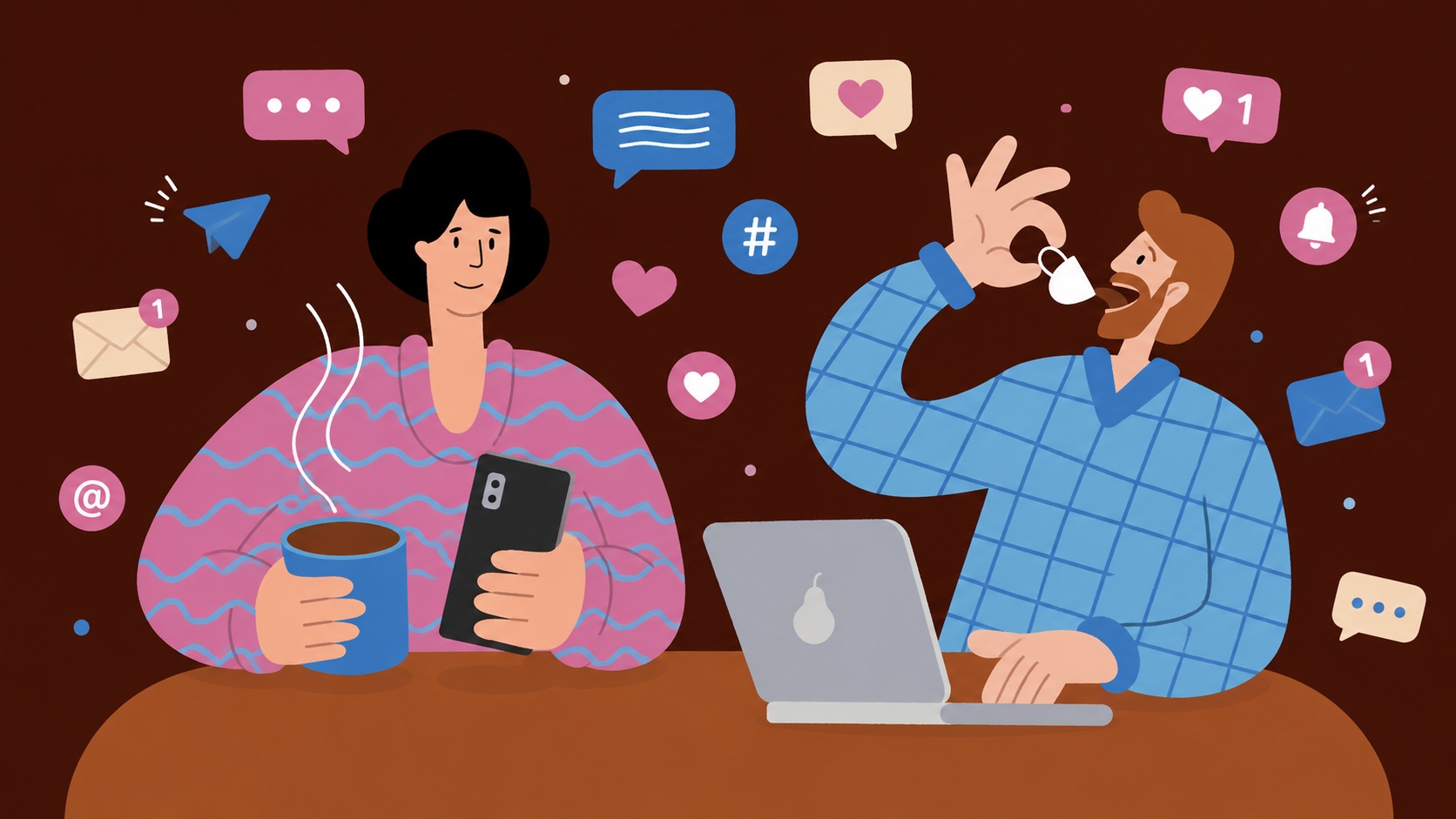
How many apps does one person depend on before breakfast?
Image: Sigrlynn | Dreamstime.com (edit)
Before the first coffee has cooled, the average internet user has already tapped into a small digital buffet. There is the alarm, the weather check, the group chat, the music app, the map, the bank app, the work login, the delivery tracker, the AI assistant, and maybe a game squeezed in before the day fully loads. Breakfast may be simple. The app stack behind it is not.
Status Is Down’s archive suggests that modern mornings are less about one “essential app” and more about a chain of dependencies, looking at nearly 19,000 outages from April 3, 2024 to June 30, 2026. Of those threads, 5,701 were posted between 5 AM and 11:59 AM Eastern Time, making up about 30% of the archive.
Based on the services tracked, a typical morning can easily involve at least seven layers of dependence before someone has even left home: connectivity, communication, payments, work or school tools, AI helpers, travel or logistics, and media or commerce. Add smart home controls, calendars, authentication apps, food delivery, shopping, banking, games, and streaming, and the count quickly climbs into double digits.
- The connection comes first, of course
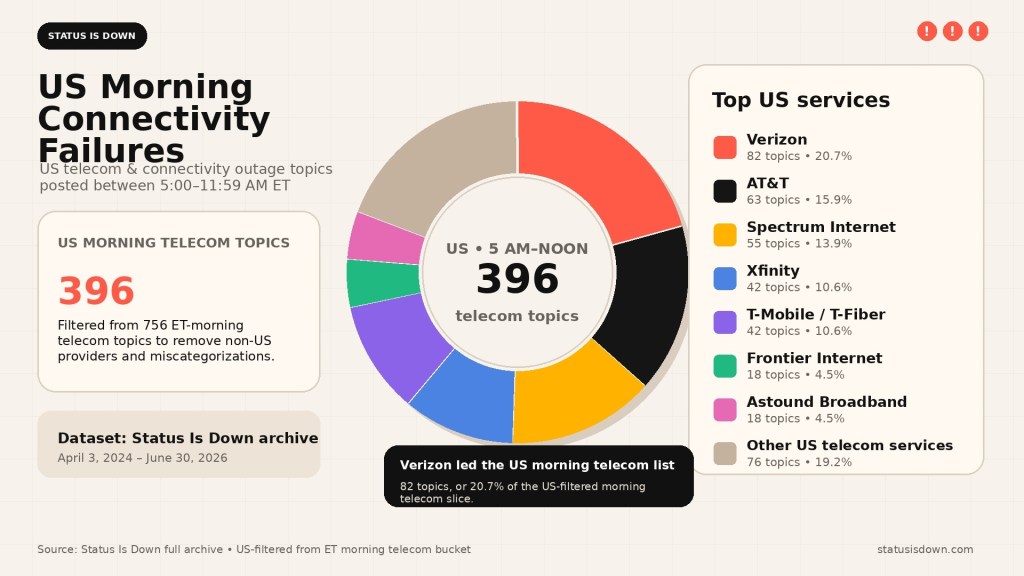
The morning app stack starts with the least glamorous of all: getting online. Telecom and connectivity services accounted for 2,817 outage topics, or 14.9% of the complete archive, forming the second most common type of problem, right after the many smaller, individual services.
That matters because no internet means almost every other app gets dragged down with it. Spectrum Internet, Virgin Media, Verizon, AT&T, Xfinity, Rogers, EE, T-Mobile, Cox Internet, and Frontier Internet all appeared among the most frequently tracked services.
- Then come the messages
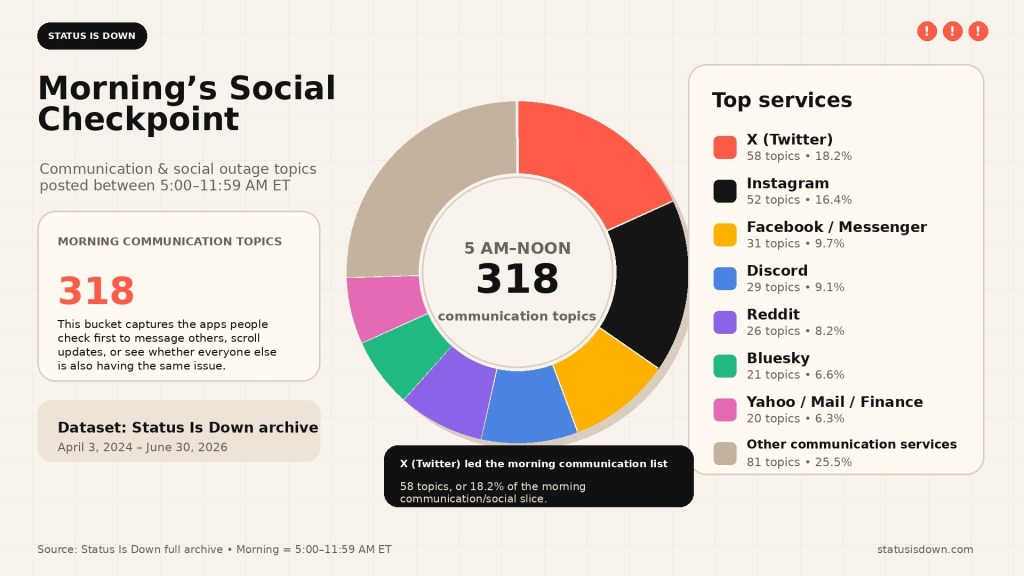
Once the connection is working, the next check is often communication. Status Is Down’s archive showed that the communication and social bucket accounted for 5.7% of all tracked topics.
Discord, X, Instagram, Reddit, Bluesky, TikTok, Facebook, LinkedIn, WhatsApp, and Yahoo Mail all appear in the wider service rankings. These are not just leisure apps. They are where people check family messages, school updates, work chatter, creator dashboards, news, customer complaints, and whether everyone else is also having the same problem.
A person may not think of “checking messages” as a dependency. But if Discord is down, Instagram will not refresh, or email will not load, the morning can start with a small information blackout.
- Money gets involved early
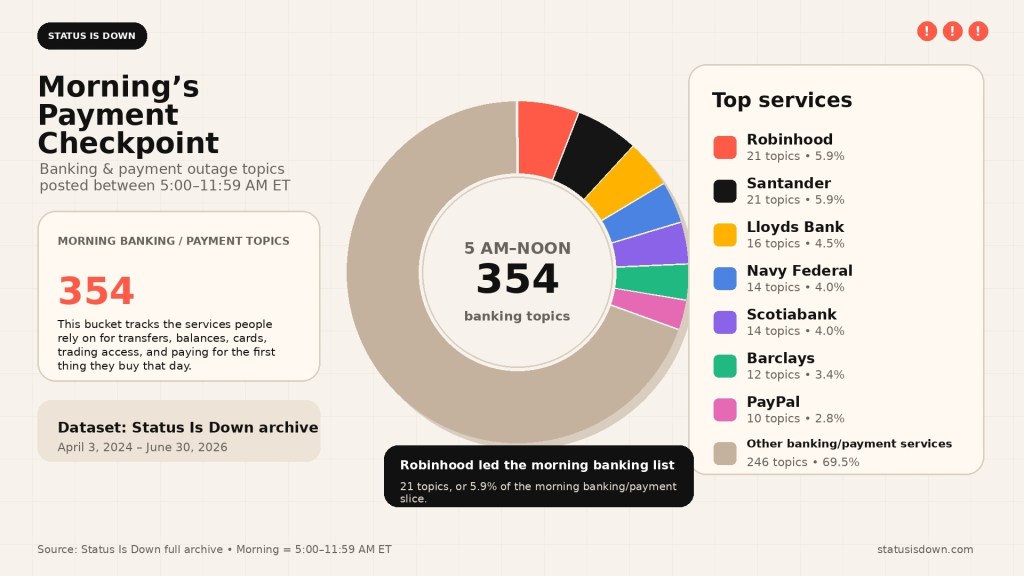
Banking and payment services made up about 5.2% of the archive. This is where the morning routine becomes more practical than social.
The services in this bucket include names such as Navy Federal Credit Union, Zelle, Scotiabank, Robinhood, Chime, Santander UK, Lloyds Bank, PayPal, Chase Bank, Wells Fargo, Barclays UK, Fidelity, RBC, and Coinbase.
Before breakfast, that might mean checking whether a paycheck landed, transferring money, paying for transit, splitting a bill, ordering coffee, or making sure a card works before heading out. When payment apps fail, they do not just interrupt screen time. They can interrupt the day’s first transaction.
- Work starts before work starts
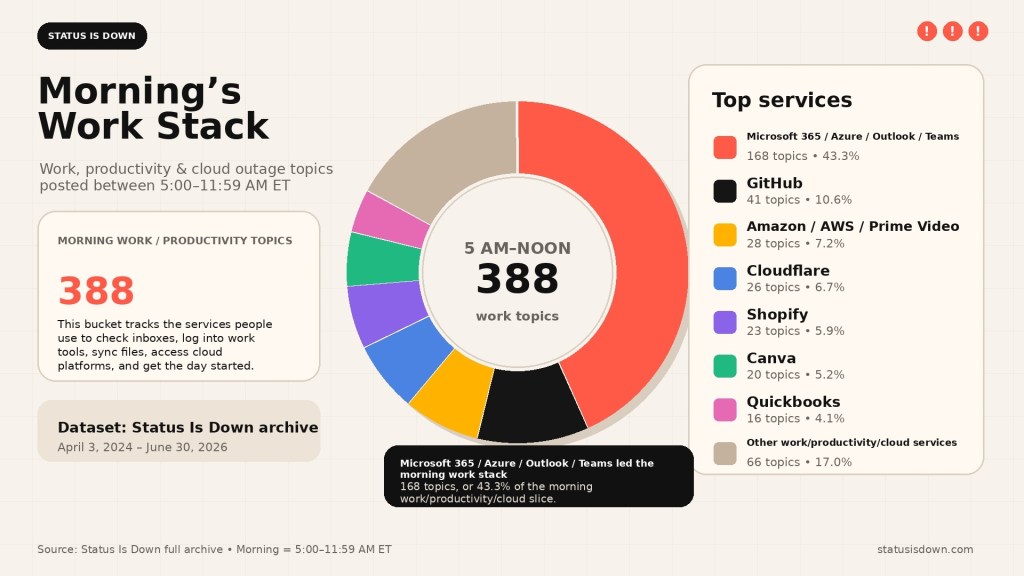
The workday often begins while people are technically still at home. Work, productivity, and cloud services accounted for 4.4% of the archive.
GitHub, Cloudflare, Microsoft Outlook, Amazon Web Services, Shopify, Canva, Microsoft Teams, QuickBooks, Microsoft 365, Microsoft Azure, Canvas, Dropbox, Zoom, Asana, Airtable, Monday.com, DocuSign, and Adobe Creative Cloud all show up across the dataset.
That turns the pre-commute window into a soft launch for the workday. People check inboxes, upload files, review dashboards, message coworkers, approve designs, schedule posts, submit assignments, or make sure yesterday’s task did not become today’s fire.
- AI is now part of the morning stack
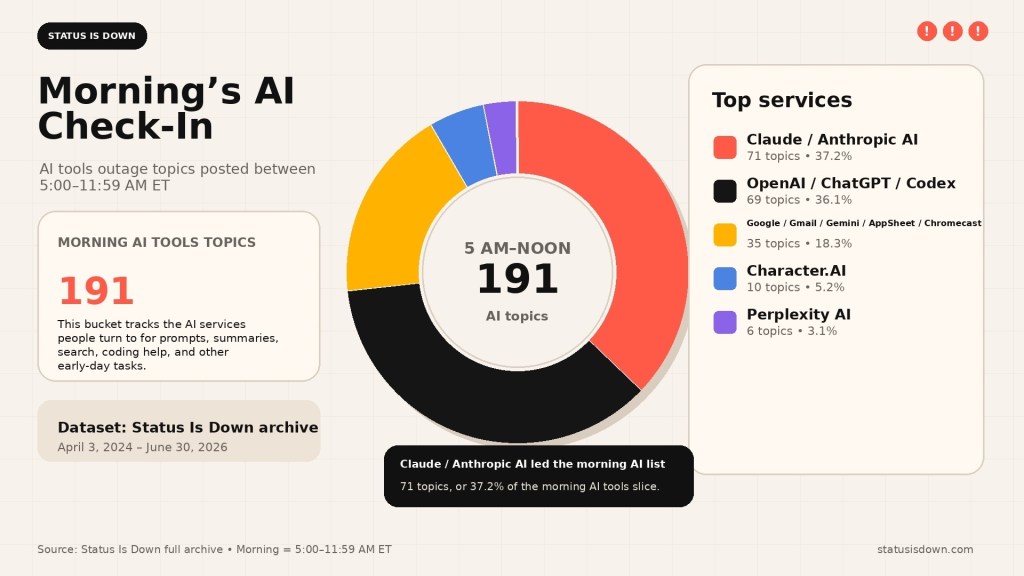
AI tools accounted for 2.8% of our full archive. That may look smaller than gaming or telecom, but the category is telling because it represents a newer habit that has quickly slipped into everyday routines.
ChatGPT / OpenAI and Claude / Anthropic AI were both among the most frequently tracked services, with Google Gemini, Character.AI, Microsoft Copilot, DeepSeek, Suno, Cursor AI, and Perplexity AI also appearing in the dataset.
Before breakfast, AI might be used to summarize emails, draft a reply, plan a route, explain homework, generate an image, debug code, rewrite a caption, or turn a vague thought into a to-do list. The morning question has changed from “Did I check my phone?” to “Which assistant did I ask first?”
- Streaming and sound are part of the ritual
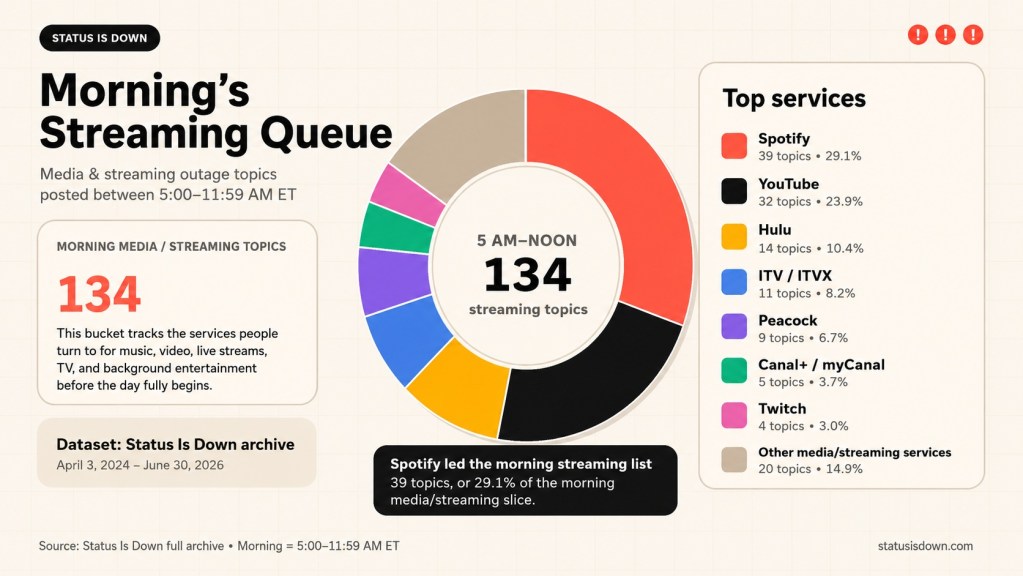
Media and streaming services made up 4.4% of the archive. YouTube, Spotify, Peacock, Hulu, Paramount+, Netflix, Prime Video, HBO Max, Apple TV, Disney+, Twitch, Crunchyroll, ESPN, and YouTube TV all appear as part of morning routines.
For some people, this is background noise. For others, it is the morning news, a workout playlist, a meditation video, a podcast, a kids’ show, or a livestream playing while breakfast happens.
It may not sound too essential until it breaks. Then the silence in the kitchen gets too loud.
- Food, shopping, and errands
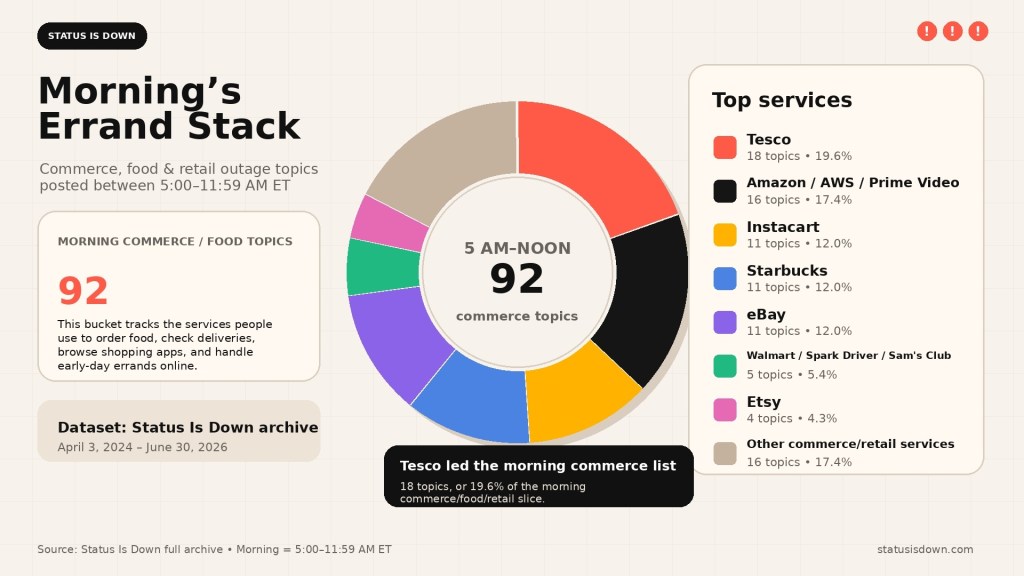
Commerce, food, and retail services accounted for 1.8% of the archive. Amazon, eBay, Instacart, Tesco, Walmart, Domino’s app, Etsy, Starbucks app, Target, Costco, Shopify, and ASDA all appear across the service list.
This is the “before I leave” pack. People check an order, reorder groceries, grab a coffee barcode, confirm a delivery window, buy something they forgot, or see whether a package is arriving today.
The apps may be small individually, but together they show how much of the morning errand list depends on a login, a payment token, and a working checkout flow.
- Travel and logistics join before the door closes
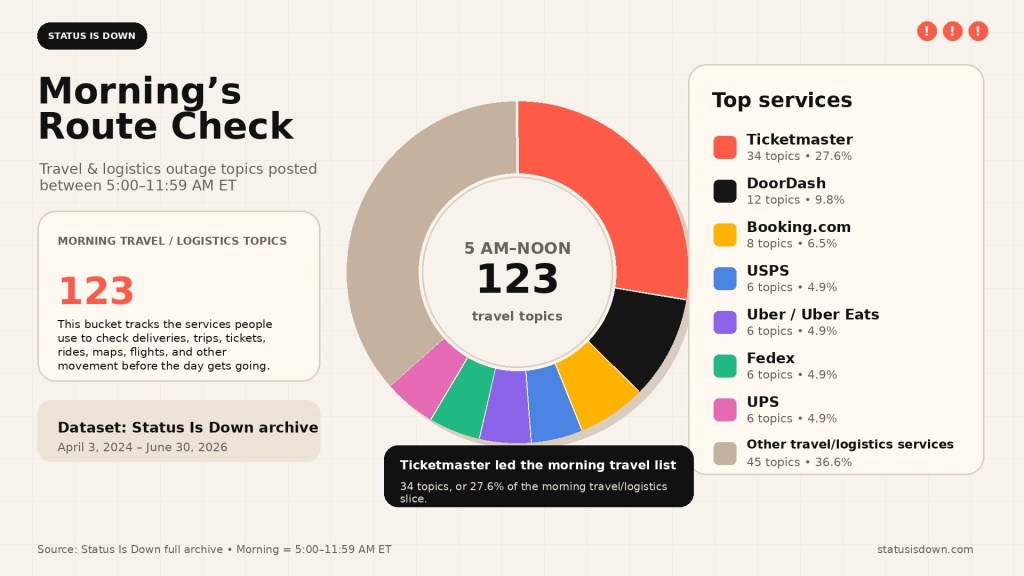
Travel and logistics services made up 2.0% of the archive. DoorDash, Ticketmaster, USPS, FedEx, American Airlines, UPS, Booking.com, Uber Eats, United Airlines, Google Maps, Royal Mail, British Airways, Airbnb, Uber, and Lyft all appear in the wider dataset.
This category reaches beyond vacations. It includes getting breakfast delivered, tracking a package, checking a flight, planning a commute, confirming a hotel, or finding out whether a delivery is stuck somewhere.
A person might not use every one of these before breakfast, but one failed map, airline, courier, or delivery app can be enough to reroute the morning.
- Gaming is not just an after-hours habit
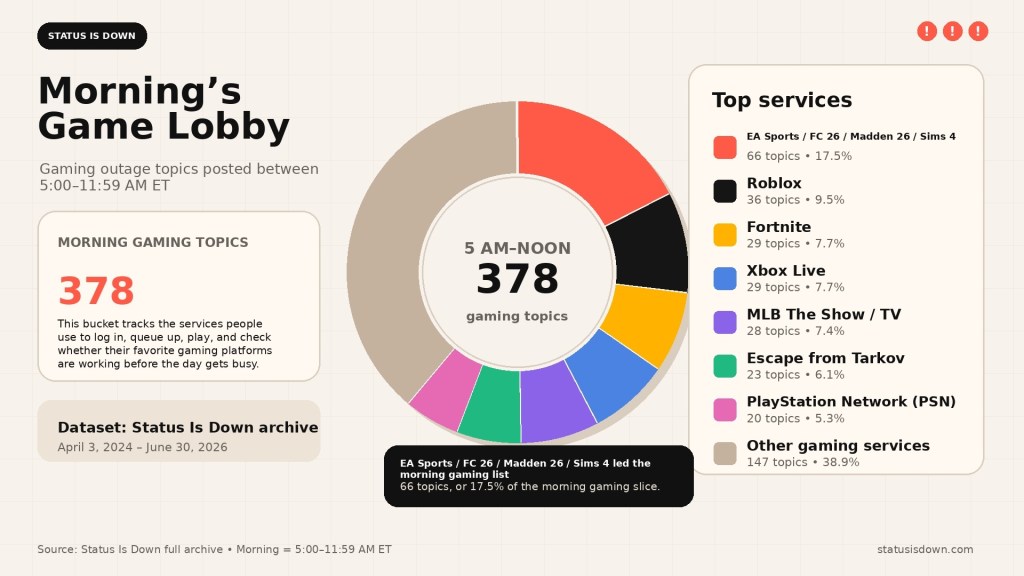
Gaming accounted for 9.7% of the archive, making it the third-busiest category. Roblox, Fortnite, Xbox Live, Steam, Call of Duty, Overwatch 2, PlayStation Network, Rocket League, Blizzard Battle.net, League of Legends, Minecraft, Valorant, Apex Legends, and Brawl Stars all feature prominently.
This may seem less “before breakfast” at first glance, but morning downtime is not universal. For students, shift workers, global players, streamers, and people checking updates across time zones, gaming services can absolutely be part of the early-day routine.
It also says something about dependency itself. Apps are not only for productivity. They are also where people socialize, compete, decompress, and keep streaks alive.
- The many smaller apps matter most
The biggest collection in the archive, with 9,188 topics, consists of other apps, amounting to 48.6% of all tracked outage posts. That sounds messy, but it may be the most accurate picture of modern digital life. This may mean fragility is spread across thousands of smaller dependencies rather than only the obvious platforms.
The before-breakfast app count is not just about the famous names. It is also the password manager, the school portal, the utility site, the design tool, the courier tracker, the niche forum, the smart device app, the bank nobody else uses, and the one service that only becomes important when it stops working.
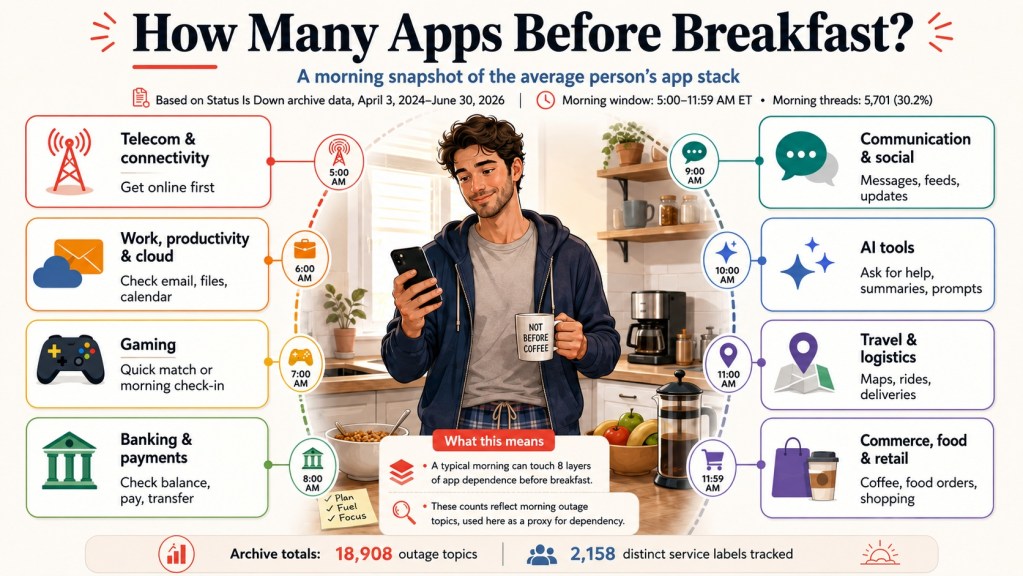
So, how many apps does one person depend on before breakfast? A conservative count is around seven core layers. A realistic count for many people is closer to 10 to 20 individual apps and services before noon. For power users, parents, students, freelancers, gamers, creators, commuters, and remote workers, it may be even higher.
The modern morning does not begin when we open one app. It begins when a whole stack of them manages to stay upright.